Sunday, November 29, 2009

MID-AUTUMN FESTIVAL

Mid-Autumn festival, also known as the Mooncake festival or the Lantern festival in Singapore, is a traditional harvest festival that is celebrated by the Chinese.


                                                              Image taken from: http://www.sinica.edu.tw/tit/festivals/0995_MidAutumn.html                                                     


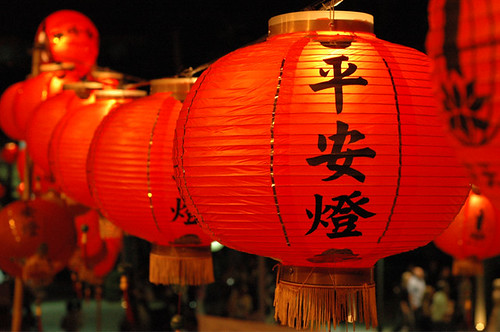
Chinese lantern, picture taken from: http://blog.giftex.in/gifting-on-occasions/hld-have-your-chinese-lantern-day-at-office/


This festival falls on the fifteen day of eighth month of the Chinese lunar calendar, which is usually around late September to early October. On this special day, the moon is believed to be at its the fullest and roundest of the year. The Chinese also believe that Mid-Autumn festival is also the birthday of the Earth God which signifies the end of hard work planting on the fields and it is time for harvesting and also the existence of the Moon God which will protect them from harm, helps to unite the family and also bless them with good fortune. On this day, they will express their gratitude towards the two gods by preparing a sumptuous spread of offerings and hopefully the two gods will continue to bless and protect them.


                                           Traditional mooncakes, picture taken from: http://celestial-winged.blogspot.com/


                                              Ice cream mooncakes, picture taken from: http://www.tutorchinese.com/UserFiles/Image/mooncake.jpg
One of the highlights of this festival is the eating of mooncakes. In the past, the mooncakes were used as a form of military communication by stuffing notes into the filling to prevent military secrets from leaking out while communicating between different units. Currently, there have been much improvisation on the mooncakes by various bakeries and pastry company. The traditional mooncakes are filled by lotus seed paste with salted egg yolk and melon seeds and are squarish, however through the improvisation they come in many different flavors, colors and shapes. We even have ice-cream mooncakes,where instead of the lotus seed paste we replace it with many different flavors of ice-cream.


                                  A scene at Chinatown during Mid-Autumn festival, picture taken from:http://upload.wikimedia.org/wikipedia/commons/4/4f/Mid-Autumn_Festival_39,_Chinatown,_Singapore,_Sep_06.JPG
There is a major celebration at the Chinatown, where it will be decorated with colorful lanterns and other decorative items. It will be a good place for you to be immersed in the Mid-Autumn festival atmosphere and at the same time educate the younger Chinese generation of this traditional festival. A three minutes long fireworks display and the launching of Kong Ming lanterns will also take place on the actual day.


You are also highly encourage to come with your creative looking lanterns and join in the Mass Lantern Walk, where you start walking from Chinatown, loop at Outram Park MRT( Mass Rapid Transport) station and end off at Chinatown again. It would be a fun and enriching experience for both adults and children!

Reference:
http://www.worldeventsguide.com/event/1343/Singapore/Mid-Autumn-Festival.html
http://sgcgo.com/mid-autumn-mooncakes/
http://en.wikipedia.org/wiki/Mid-Autumn_Festival

YOUTH OLYMPIC GAMES

 The biggest event of the year of 2010 for Singapore will be none other then the Youth Olympic Games (YOG), which will be held in mid August.


                                                 YOG logo, taken from: http://www.damaipri.moe.edu.sg/yog/LogoYOG2010a.jpg
The concept of the Youth Olympics is proposed by the president of the International Olympic Committee, Jacques Rogge in 2001 and was later approved on July 6, 2007.


                The mascots for YOG, taken from:http://www.olympic.org/en/content/Media/?articleNewsGroup=-1&articleId=74913&CalendarTab=1


The goal of YOG is to gather all the talented youth athletes to inculcate the Olympic values of Excellence, Friendship and Respect in them, so as to create an ideal sporting environment and keep the spirit going forever. They also hope to bring the sporting culture regionally and globally up to higher levels.


YOG pictograms, taken from: http://www.sgyoutholympics.com/2009/05/29/pictograms-of-the-singapore-youth-olympic-games-2010-sports/

The YOG is a scaled down version of the Olympics games which consists of 26 sports like 3-on-3 basketball, swimming, archery,aquatics, badminton, athletics, fencing, boxing, canoe-kayak, cycling, football,gymnastics,handball, hockey, judo, modern pentathlon, rowing, sailing, shooting, table tennis, taekwando, tennis, triathlon, volleyball, weight-lifting and wrestling.

The matches will be held island-wide, thus if you are interested in watching the games then, you can refer to the YOG website for further updates on the games and timing.

Reference:
http://www.olympic.org/en/content/Sports/
http://www.olympic.org/en/content/Olympism-in-Action/
http://www.singapore2010.sg/public/sg2010/en.html

Friday, November 13, 2009

DEEPAVALI

 Deepavali, the festival of light, is a highly symbolic day for the Hindus and falls in between the period of October and November. This festival is also known as Diwali and it often mistaken as a celebration of the Indian New Year. Deepavali actually celebrates not the new year but rather the new beginning.In Hindu mythology, this is the day where Lord Krishna defeated the evil demon, Narakasura. Thus, it is the celebration of light over dark which is good over the evil.

                                    Hindu Temple, picture taken from: http://www.onehourtourist.com/activity/?act=view&id=4575


Devotees will have to go through many rituals during Deepavali. They have to take oil baths, which symbolize purification and a new beginning, before they visit the temple. At the temple, they will have to break coconuts, The hard shell of the coconut represents egos and pride and the white flesh represents humility and purity, thus the hard shell need to be broken in order to attain the two virtue represented by the white flesh.


                   Picture of Indian oil lamp taken from: http://asylum60.blogspot.com/2006/06/putting-conservative-muslims-fear-into.html

On this day, the devotees will also light the oil lamp in the house as they believe that the light from the lamps will guide the wandering souls of the departed to the correct path. This practice originated from one of the Hindu Mythology in which Lord Rama returned to Ayodhya after a fourteen year exile and a battle in which he killed the demon king, Ravana. It is believed that the people of Ayoghya lit oil lamps along the way to light his path in the darkness.

 
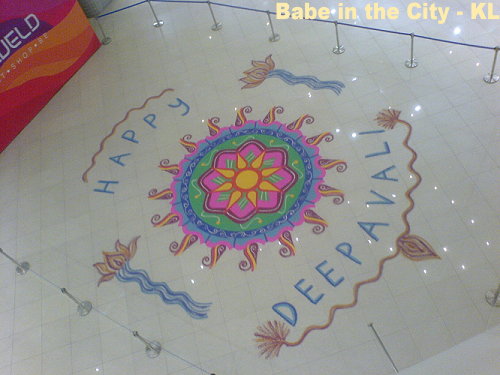
                                 Deepavali Kolam, picture taken from: http://babeinthecitykl.blogspot.com/2007_11_01_archive.html

                                                                           
The Hindus will decorate the entrances to their home with a kolam for the festival. The kolam is a complex floor drawing coloured with different hues of rice powder that is meant to invoke the blessing of Lakshimi, the Goddess of Wealth. All kolams are symmetrical as it represents the idea of universal balance and this is one of the key values of Hindu beliefs.


                                                              Little India at night
 

Other than these domesticated practices, we have a public celebration for Deepavali as well. Thus, even if you are not a Hindu, you still can join in this festive ocassion where most of the related activities will be held at our very own Little India. The street lights on the road along Little India will be decorated with thousands of twinkling light bulbs shaped elaborated design and symbols that are unique to the Indians. The whole street will look absolutely stunning and gorgeous when the night falls.


                                                                Stage Performances


                                                              Performing groups

They will also bulid a temporary stage for cultural performances and a countdown concert. Professional dance troupes and singers will be invited to this event to perform. Thus, all Indians will gather there to sing and dance along with the music and celebrate Deepavali together.


                                                                    Deepavali Bazaar


                   A video that shows the Deepavali market, taken from youtube user ' goforthe hole'


The other highlight of the event will be the Deepavali Bazaar where you can find all sorts of festive food, ethnic clothing and Indian artefacts. It would be an interesting and enriching experience for you to visit Little India during the festive season as the essence of their culture will all be featured in these activities and performances which would be rare to see at other times.

Reference:
http://www.travel-singapore.com/events/november.htm
http://www.etour-singapore.com/deepavali-in-singapore.html
http://sparklette.net/events/little-india-street-light-up/
http://www.singaporesights.com/sight/deepavali-2009-little-india

CHINESE NEW YEAR

The Chinese New Year, also known as the Spring Festival, is widely  celebrated in Singapore, due to the fact that a large proportion of the population is Chinese. This festival falls on the first day of the lunar calandar which is usually in the month of January or February.Each year is represented by an animal and the order of the animals repeats evry twelve years. The animals are in the order of mouse, ox, tiger, rabbit, dragon, snake, horse, sheep, monkey, chicken, dog and pig. We are currently in the year of ox, thus the following year of 2010 will be the year of tiger.


                              The Chinese Zodiacs, taken from:http://mastaazumarek.deviantart.com/art/Chinese-Zodiac-Girs-110860230

When Chinese New Year is around the corner, you will find most of the local Chinese residents spring-cleaning their house. They believe that if they do not clean their house before the New Year arrives, the bad luck accumulated from the last year will be carried forward to the coming year.


                                    Chinatown Street Market, picture taken from:members.virtualtourist.com/m/tt/472a2/

Other than cleaning up the house, most of the Chinese families will make a trip to Chinatown, which is located along Terengganu Street and Pagoda Street. A temporary street market will be set up and the whole street will be decorated with colourful lanterns. The street market sells a large variety of New Year goods ranging from food to decorative items. The Chinese believe that red symbolises good luck and prosperity, thus most of the items you can find in the street market are red in colour. They will buy auspicious motifs and decorative items to decorate their houses so as to give the house a brand new look to receive the arrival of the New Year.


                                                                        Ang Bao


On the eve of the Chinese New Year, families will gather and eat dinner together to signify unity and harmony within the whole family.There is a folk belief that if the children stay up till the actual New Year day, they actually can prolong the lifespan of their parents, thus most people will stay up late on the New Year's eve. Once the clock strikes twelve midnight, the children will pay their respect to their parents and elders with two mandarin oranges which is to symbolise good luck. In return, the elders will give the children a red packet, better known as Ang Bao or Hong Bao, as a token of good luck and blessing from them.


                                                 Entrance of the Ang Bao River

Other than the domestic celebrations, there is another highlight of Chinese New Year which is the River Hong Bao. This is an annual event that is held in Singapore to showcase Chinese culture performances, traditional art and food stuff. This is usually held at  Marina Bay and would last for a month. There will be programmes scheduled which includes song played by the Chinese Orchestra, display of Wushu moves by Chinese martial arts experts and traditional Chinese dance by professional dance groups. You can also find a range of Chinese-related items ranging from Chinese painting, tradition Chinese paper-cuttings to delicious and mouth-watering snacks and dishes. It is free admission, thus you can choose to spend the whole day there and be immersed with the rich Chinese culture.


                                                                 Chingay performance

                                                         Video taken from youtube user,'xiaobat'


                                                          Video taken from youtube user, 'DanceEuphoria'


The Chingay parade is another major celebrating event that will happen during the Chinese New Year period, it is the grandest and largest scale street parade we have in Singapore. It is held  on the first weekend of the Chinese New Year, therefore it does not have a fixed date. This Chingay parade was first introduced in the 1973 and featured only traditional acts by locals. However due to its great popularity and success over the years, it was expanded to become a large scale events with very elaborated floats, many different genres of performances with more than six hundred participants that are from all parts of the world. On the actual day of performance, there will  be a magnificant and extensive display of fireworks and fire crakers. So do come and join in the fun and joyous occasion!


Reference:
http://en.wikipedia.org/wiki/Chinese_New_Year
http://www.visitsingapore.com/cny/
http://www.c-c-c.org/chineseculture/festival/newyear/newyear.html

Thursday, November 5, 2009

HARI RAYA PUASA


The Malays in Singapore share their festive calendar with many Muslims across the world. One of the most significant and major Malay festivals celebrated will be Hari Raya Puasa, also known as Hari Raya Aidilfitri, which literally means the 'celebration day of fasting'. It falls on the first day of the tenth lunar month of the Islamic calendar.

The Muslims will start to fast one month before Hari Raya Puasa, this month is known as Ramadan. They will wake up before the sun rises to pray and eat breakfast. After this early meal, they will not take any more food or liquid till the sun sets and this will last for the whole month of Ramadan.

                                       Picture taken from: http://www.ameinfo.com/news/Company_News/S/Singapore_Tourism_Board__STB_/


In the meantime, the Muslim families will also be busy preparing for this celebration. They busy themselves with buying new household items and clothing, baking cakes and cookies and cleaning up the house. The purchasing of new items and clothing signify renewal and celebration, which is part and parcel of the their culture. They will usually make their purchases at Gelyang Serai, where a temporary street market will be set up specially for the preparation of the Hari Raya Puasa. They will sell a wide variety of things, ranging from food to clothing, and even potted plants. The males will wear Baju Melayu and the females will wear Baju Kurung or Bajy Kebaya. They are usually very brightly coloured and sometimes with floral prints on it. You can pay a visit to Geylang Serai to enjoy the festive atmosphere,buy the traditional clothing and taste delicious Malay delicacies during the Ramadan Period.

A type of Malay cookies

Baju Kebaya( for females)

Baju Melayu ( for males)


On the morning of Hari Raya Puasa, children will greet their parents for their forgiveness on their wrongdoings for the past one year and blessing for the coming year. After this ceremony, the whole family will cleansed themselves,dressed up in their new clothing and visit the mosque.


Sultan Mosque

During the festival, it is customary for friends and relatives to visit one another to exchange good wishes and delicacies that are specially made for the occasion. Children will also receive Duit Raya, which is a token sum of money wrapped in a green envelope. The Malay delicacies include beef Rendang, cookies and cakes, Ketuput and Satays.


Satay and Ketupat

Even though this festival last for one month traditionally, but in the highly urbanized Singapore, most of the activities will only take place in the first three days of celebration.

Reference:
http://infopedia.nl.sg/articles/SIP_919_2004-12-20.html
http://www.experiencefestival.com/hari_raya_puasa
http://en.wikipedia.org/wiki/Hari_Raya_Aidilfitri
http://www.pahang-delights.com/pahang-traditional-Malay-costumes.html
http://www.marimari.com/cOnTENT/singapore/food/malay/malay.html

FOREWORDS

Welcome to the vibrant and exciting country, Singapore!


Being multi-cultured and multi-religion constitutes to the unique culture we have on Singapore. It is not surprising to find a temple and a mosque co-existing on the same road, as we respect each and every cultures and religions and we live together in harmony.


Singapore consists of a population of more than four million people, with Chinese making up the majority with a percentage as high as 75%, followed by Malays(14%), Indian(9%) and others(2%). Even though it is a Chinese dominated society, every citizen enjoys equal rights and freedom. Thus, we would celebrate all major festivals that each culture or religion has.


Besides being a multi-cultural country, we are also a country that has no natural resources to count on for economic survival. We have to rely heavily on trade and tourism to sustain the economic development for Singapore. Therefore, the government has been actively building world-class facilities and amenities to attract foreign countries, so as to make Singapore their travel destination for holding events and conventions.


In our Blog, we will be introducing and promoting some on-going events and traditional festivals that is unique and exclusive to Singapore. We hope that the information provided by us will be able to help you understand Singapore better.

Thank you for visiting! =)